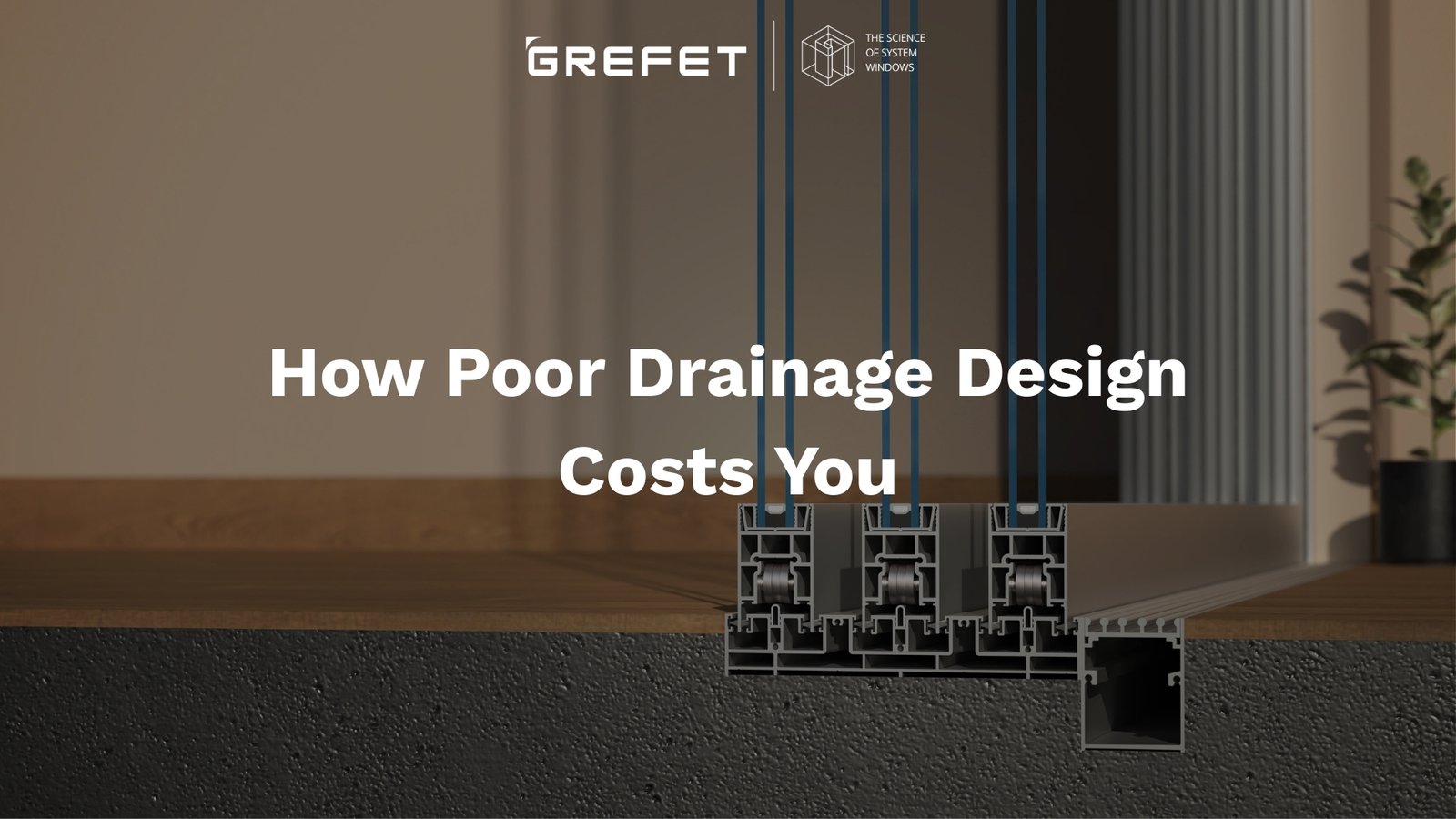
You rarely ever hear people discuss drainage when it comes to aluminium windows and doors. Profiles, glass, hardware, yes. Drainage no. That’s exactly the problem. We have witnessed at GREFET how poor drainage design costs you and silently erodes performance, reputation, and longevity. Let’s break it down.
How A Bad Drainage Design Can Cost You Down The Line
Drainage does not mean preventing any water from entering at all. You are always going to get some water in there. The system’s ability to process it and get rid of it is what counts. Once you compromise the design of your drains, the effect will become noticeable sooner than you think.
How Bad Drainage Design Costs You From Water Penetration
The first and most visible one is leakage. The drainage paths are so poorly thought out that water pools inside the frame.
This leads to:
- Seepage during heavy rain
- Damp patches around window reveals
- Water marks on internal finishes
The complaining is hard to both trace, and once it becomes visible online, to fix. What this actually translates to is unnecessary callbacks and on-site firefighting.
What Bad Drainage Design is Really Costing You in Damaged Hardware
Water that gets caught in the system does not just idle. It attacks everything around it.
Common outcomes include:
- Corroded rollers and locking points
- Reduced hardware life
- Noisy or jammed shutters
- Premature replacement of expensive components
But at GREFET, we’ve discovered that nothing performance hardware hates more than neglecting adequate drainage.
High Costs of Poor Drainage Design on Performance
Impeded or improperly constructed drains reduce gasket pressure and frame squareness with age.
The result:
- Reduced airtightness
- Higher air leakage
- Poor acoustic performance
- Loss of thermal efficiency
So even if the window was perfect on day one, you’re slowly losing performance. And the client notices.
Lack of Drainage Design in Fabrication and Installation Time
Bad drainage is not always visible on plans. It’s something fabricators and installers come across quite a bit in the field.
This causes:
- Improvised drilling or slotting
- Inconsistent workmanship across projects
- Higher chances of human error
- Wasted time during installation
A system must be designed to ensure proper drainage, and not depend on site jugaad.
The Price You Pay for Poor Drainage Design
Leaks don’t just damage buildings. They damage trust.
One leaking window can:
- Overshadow an otherwise good project
- Lead to negative word-of-mouth
- Affect repeat business
- Create tension between fabricator, architect and client
In our experience drainage failures are not quickly forgotten, even if the design successes are.
How GREFET Does Drainage Well
Drainage is designed into the system, rather than added on with GREFET.
Our approach includes:
- Clearly defined internal water paths
- Proper slope and chamber design
- Strategically placed weep holes
- Compatibility with gaskets and hardware
- Testing under Indian climate conditions
This means water flows in, around and out where it is supposed to.
Why Drainage Design Has Become Mandatory
Indian weather is getting harsher. More intense rains, longer monsoons, stronger winds. Drainage can no longer be an afterthought. How poor drainage design is costing you isn’t just a technical question. It’s a business one. And the answer is straightforward: It’s more expensive than doing it right the first time.
At GREFET we understand that good systems protect, not just buildings, but the people and brands behind them.


