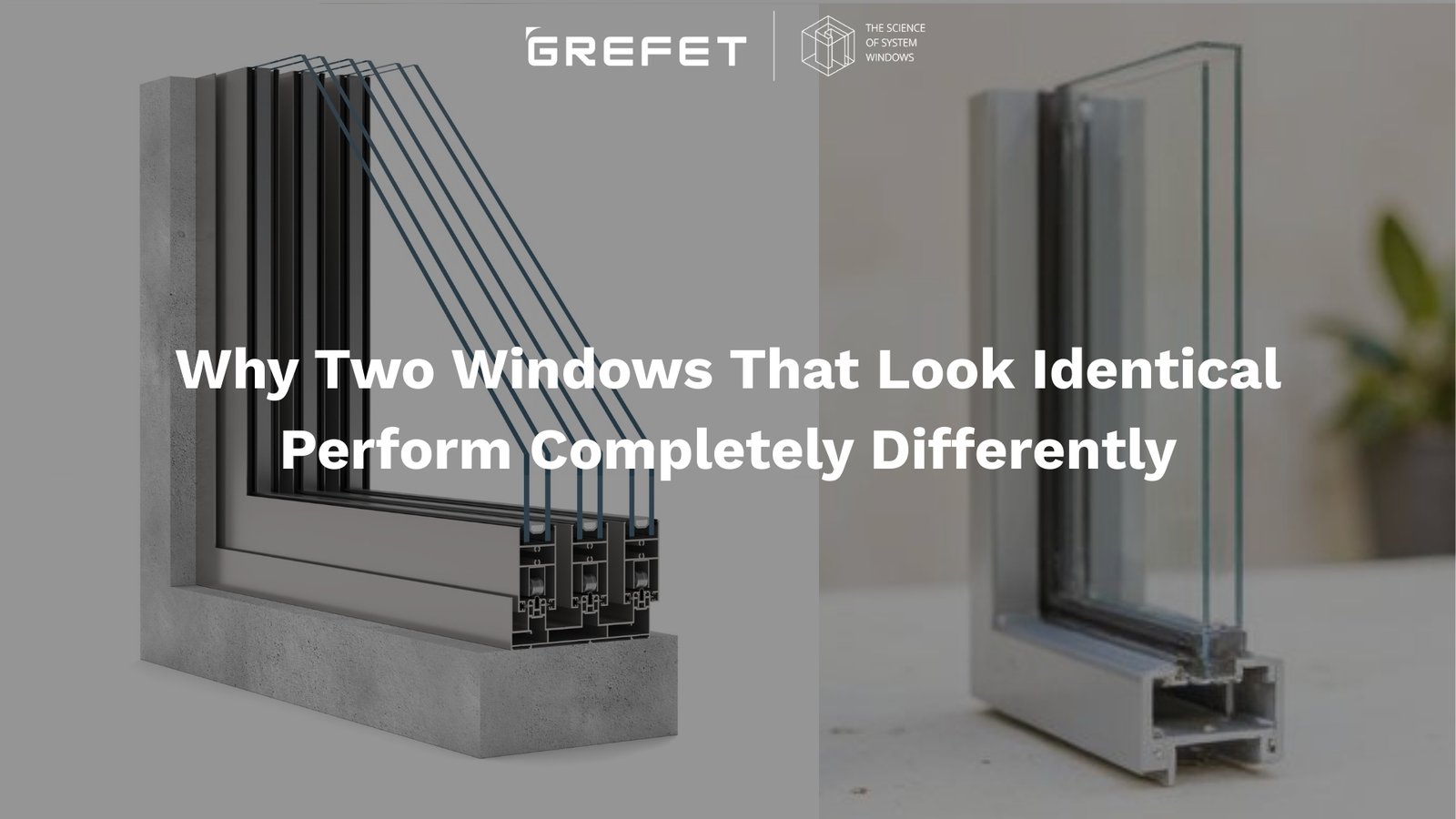
Spend a day walking through any residential or commercial project, and this is apparent immediately why two windows that look identical perform completely differently. Two aluminium windows. Same colour. Same glass. Exactly same sightline. Another stays quiet, dry and smooth year after year. The other let air out, rattles or gets tired much too soon.
What this actually says is quite straightforward: windows are evaluated by what you see, but they work thanks to what you don’t.
This is the part where most decision make trails at GREFET.
Appearance Is Easy. Performance Is Engineered.
In the Indian market, windows are frequently chosen by sight. Profile thickness, finish or brand name makes the final decision. But performance isn’t skin deep.
Two windows of the same appearance can vary in:
- Internal chamber design
- Drainage and water evacuation paths
- Sealing logic and gasket continuity
- Hardware load distribution
- Frame and sash alignment tolerances
None of which, of course, appears in a photograph or on a showroom floor.
Everything is up to the System in the Window
And why two identical looking windows do completely different things often lies in whether the window is a system or is fabricated. A programmed aluminium window is made to the whole as a complete unit. Profiles, gaskets, hardware and glass are supposed to adhere against pressure, wind, rain and that constant opening and closing.
Here’s an example of how that might look in a non-system window (if you play it real safe), but it’s highly skill-dependent and site variable. That’s where inconsistency begins. We in GREFET can observe this difference very distinctly once the site has withstood the first monsoon.
Sealing Is Not About Rubber. It’s About Logic.
It’s not because a gasket is absent that most failures occur. This happens because designers treat sealing as an add-on instead of a primary design principle.
Key differences that affect sealing:
- Continuous vs broken gasket lines
- Correct compression zones
- Pressure equilibrium between sash and frame
- Corner integrity after installation
When you do, water and noise come in through the cracks, no questions asked.
Hardware Has More Responsibility Than You Assume
Hardware is often chosen last. Sometimes downgraded quietly.
But hardware controls:
- How evenly the sash closes
- Long-term alignment
- Load transfer to the frame
- Smoothness after years of use
Simply put two identically looking windows with different hardware spec’s that will age massively differently. One holds its geometry. The other fights gravity.
Installation Completes the System
Even the most well-conceived system can fail when installation overlooks system rules.
Common site-level differences:
- Incorrect anchoring points
- Uneven shimming
- Forced alignment
- Improvised drainage solutions
This is why certified fabrication and system discipline are more important than marketing hyperbole.
What This Means for Architects and Buyers
Why two windows that look identical perform completely differently is no mystery. That’s a function of early decisions and quiet compromises.
At GREFET, we create aluminium window systems that not only provide form, but also function even after day one. Since in many cases of Indian operating environments, real performance does not manifest itself until another two or three seasons after the site is handed over.
When we treat windows as systems rather than surfaces, the distinction becomes clear.


